South Central Guatemala is a land of volcanoes! On one of our tours someone shared a perspective that Guatemala’s geography is like the U.S. but compressed into 200 miles. In the U.S., the Atlantic Ocean is to the east and the Pacific is to the west; however, in Gautemala the Atlantic is to the north and the Pacific is to the south. And while the Guatemalan distance from Atlantic to Pacific is only 200 miles, the geography changes like it does in the U.S. – smaller mountains near the Atlantic Ocean, a flat plains region, then higher and more rugged mountains (where the volcanoes are concentrated) leading to the rockier shores of the Pacific coastline.
From the town of Antigua, at least 3 volcanoes were readily visible (Agua, Acatenango, and Fuego). During our tour of a church in downtown Antigua, we witnessed Fuego actively emitting smoke.
The second half of our trip we visited Lake Atitlán. This deep lake is about 5 miles in diameter. We learned the lake is actually the caldera of an ancient super volcano. Today, the lake is ringed with younger volcanoes, most of them still active as they are essentially vents for the original volcano.
The region of south central Guatemala is located above three tectonic plates, which accounts for the volcanic activity. The region experiences regular earthquakes and tremors, some of which have destroyed towns. Antigua was once the capital of Guatemala, but when an earthquake in the 16th century destroyed most of the buildings, the capital was moved to its current location in Guatemala City, relatively less active.
The mountains are very steep and roads very windy. Absolutely gorgeous. If you love mountains as I do, Guatemala may become your surprised most-loved central American country.
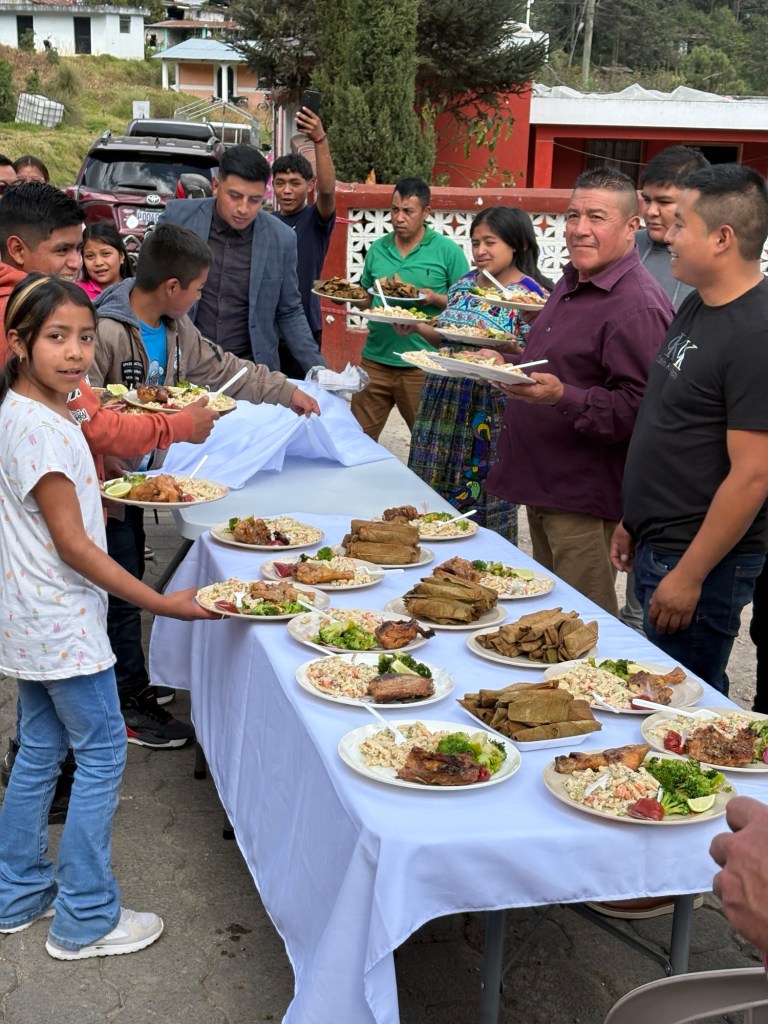
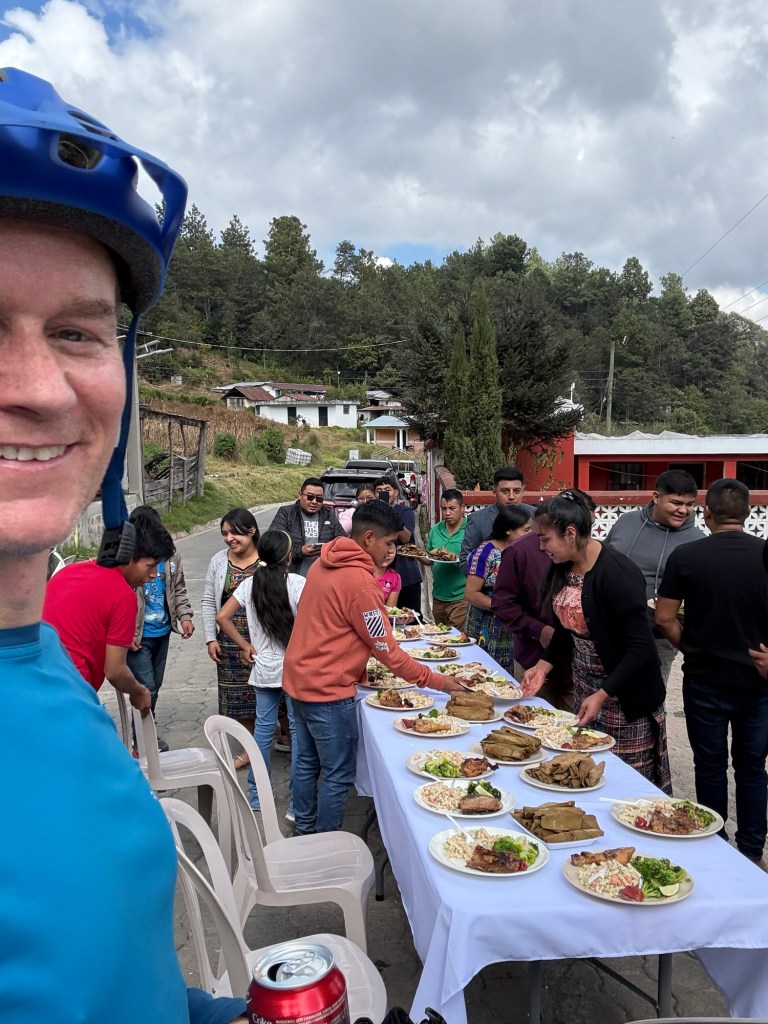
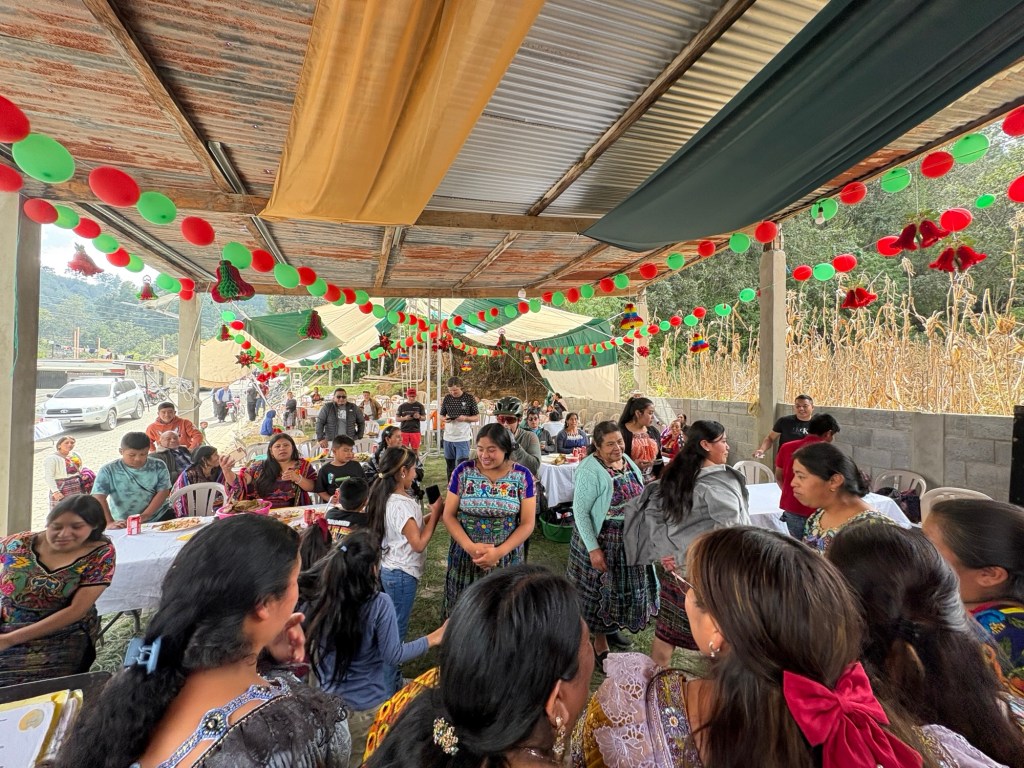
An hour or two into our mountain bike tour, the route took us up a hill into a rural Guatemalan village. Nothing unusual about that, but the village was having a party. Large tents, maybe 100 people, and a full band playing Christmas carols. We learned that one of the families in town had had a prosperous year and was treating the town to a party. That was pretty cool all on its own, but one of us expected what happened next.
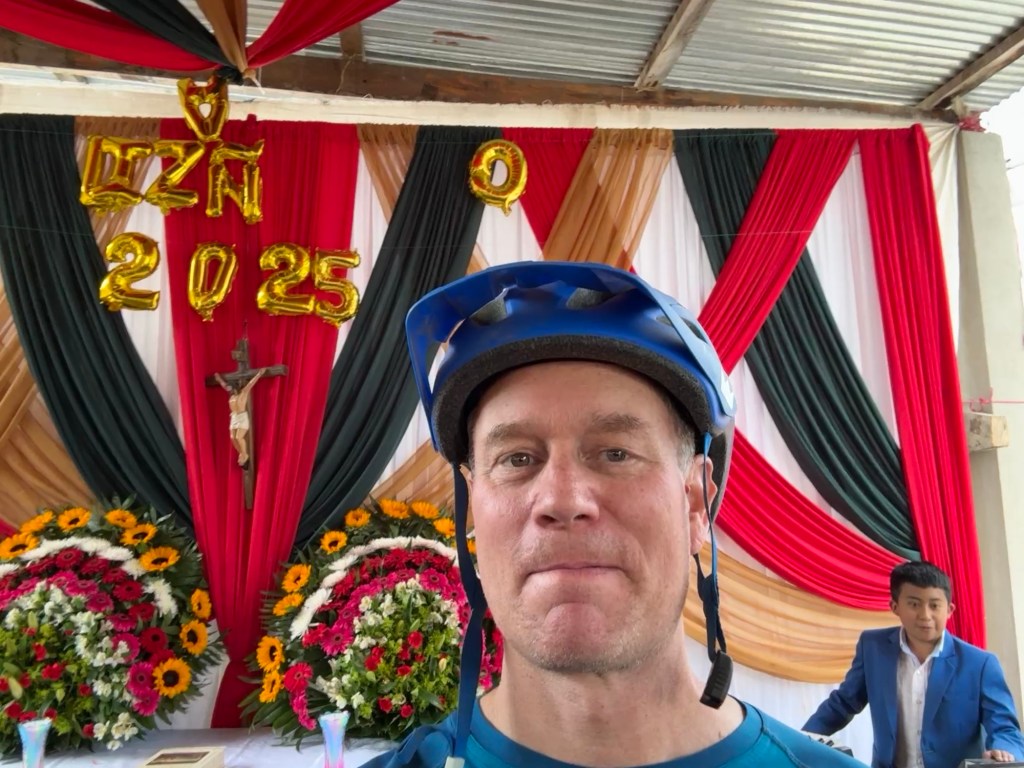
When the host of the party learned we were touring the area on bikes, he insisted we join in the celebration and invited us to sit down for lunch. Our tour leader, Brendon, initially declined but they pressed until he accepted. It was unbelievable how quickly tables and tablecloths and chairs appeared. They set up a spot for us – a group of 10 bike riders! – right there on the road. Plates of food magically appeared, and we sat and rested and ate and celebrated with the village. It was amazing that we arrived just exactly at that moment, and even more amazing they invited us to their feast. They could have simply smiled and given us a friendly wave. You can’t make this stuff up, and I’m now convinced the Guatemalan people are the friendliest on earth.
We went to Guatemala! Michelle and I had a wonderful trip filled with learning, adventure, new foods, making new friends, and strengthening our relationship. Now on the flight home I’m taking some time to capture our day-by-day activities, mainly so we can remember what we did!
We arrived on Christmas Day 2024 and spent three nights in Antigua, Guatemala followed by three nights in Panajachel, Guatemala for a total of six nights. We returned to Colorado on New Year’s Eve.
DAY 1: Wednesday 12/25 – Travel day
Boulder>Denver>Houston>Guatemala City>Antigua.
Highlights: Dinner at Arrin Cuan. We found this by walking around the neighborhood, and stopping in any place that was open on Christmas. Our first taste of Guatemalan food. Delicious, rich flavors and mainly meat-based dishes.
Lowlights: None! No hiccups in our travel day.
DAY 2: Thursday 12/26 – A day touring Antigua
Highlights:
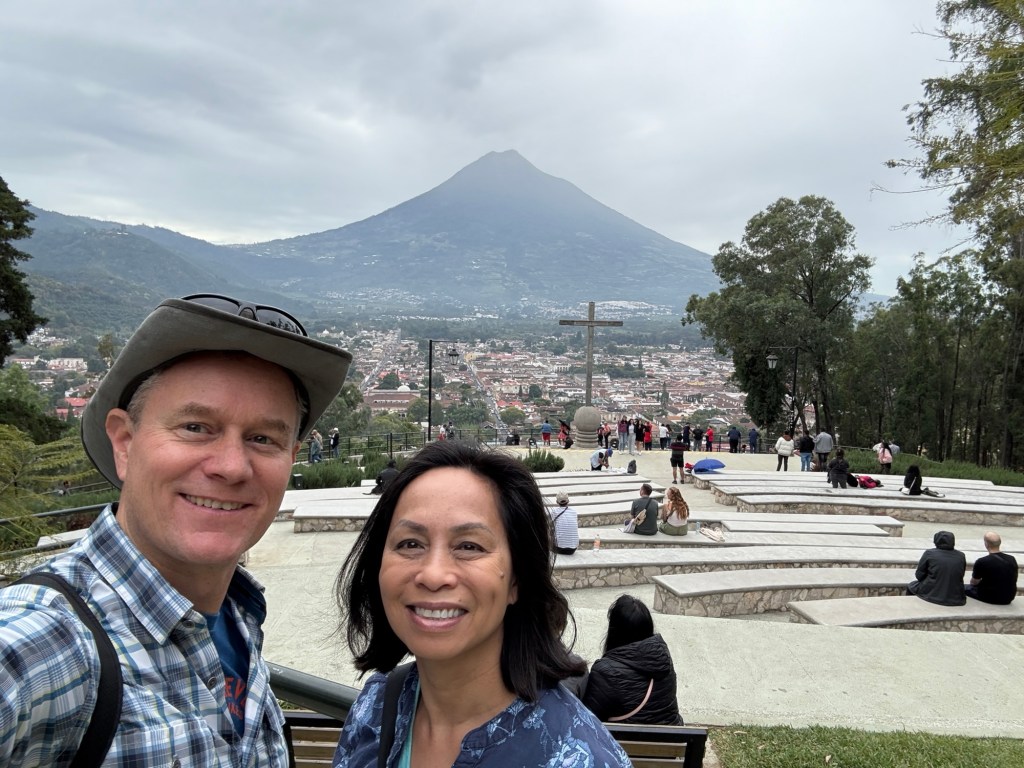
Cerro de la Cruz. Great way to start the day with a view from a terraced public park above the city.
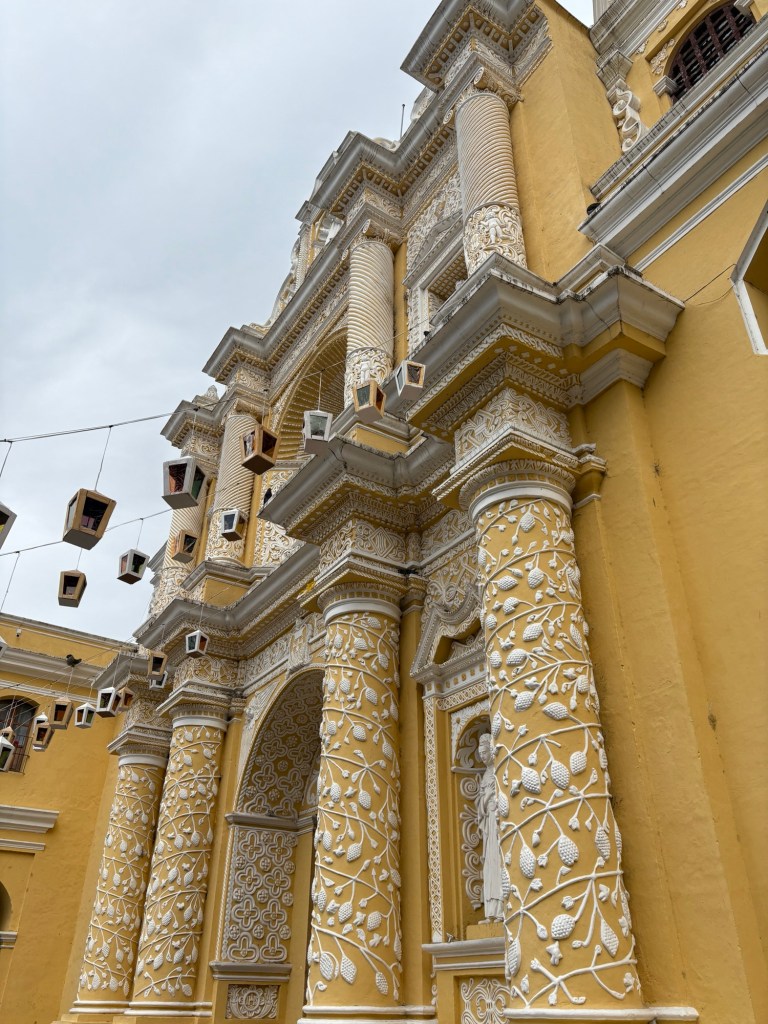
Eruption of Fuego Volcano. We took this video from the rooftop of Iglesia de la Merced, another church that we toured (Q35 entrance fee*).
Iglesia de La Merced
Vulcan Fuego spewing
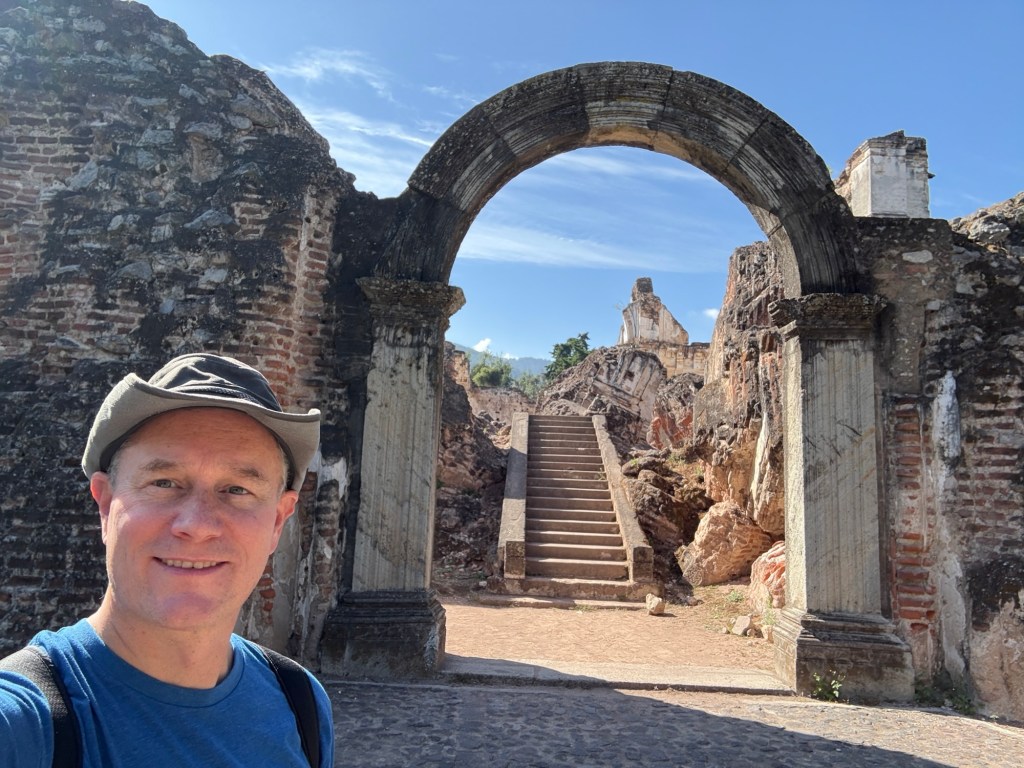
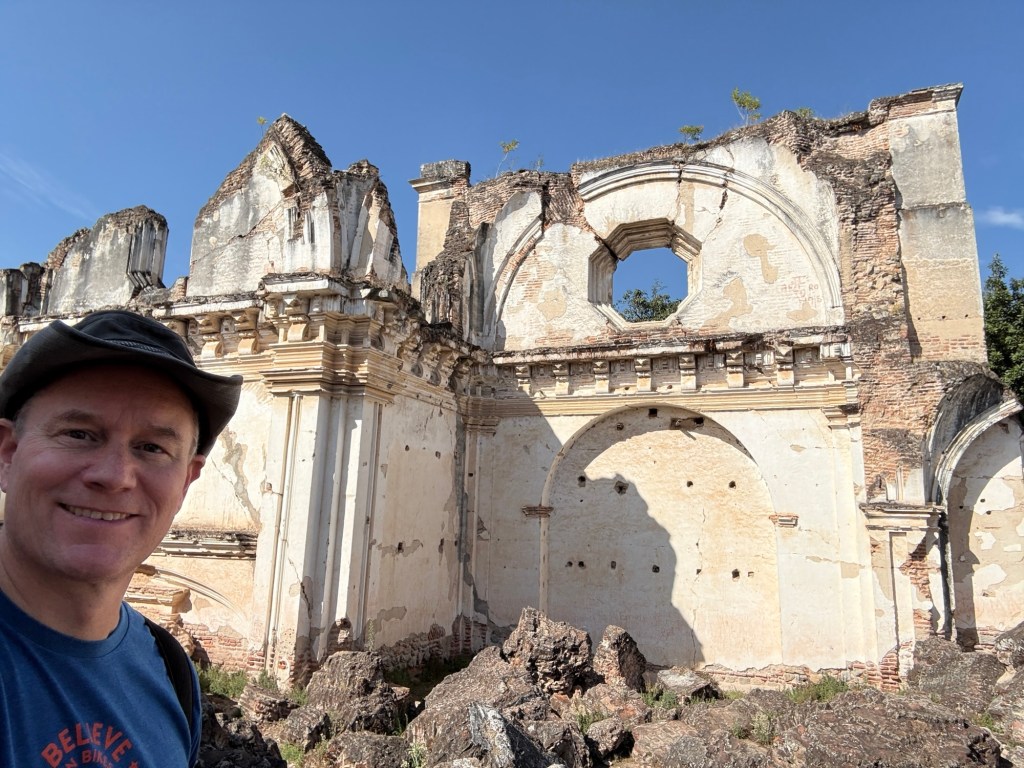
Convento la Recoleccion Ruins. This was once a Catholic church and monastery. After the Q40 entrance fee*, you can walk and scramble over the ruins. There are super cool octagonal windows still intact – but check out those cracks!
Ruins at Convento La Recoleccion
* One U.S. dollar is about 7.5-8 Guatemalan Quetzal (GTQ). So Q40 is about $5-6.
Dinner at Hector’s Bistro. We had read about this place in multiple guidebooks, and it was worth seeking it out. Delicious French food. We met a mother/daughter on the plane from Houston. Turned out they were our neighbors at the hotel. And they had dinner at Hectors the same night as us. We sent them a surprise dessert.
Lowlights:
All the cobblestone streets did a great job slowing down the cars. But they also worked our feet, especially Michelle’s.
The ruins at Convento la Recoleccion smelled of urine. Yuck.
DAY 3: Friday 12/27 – Hike a Volcano
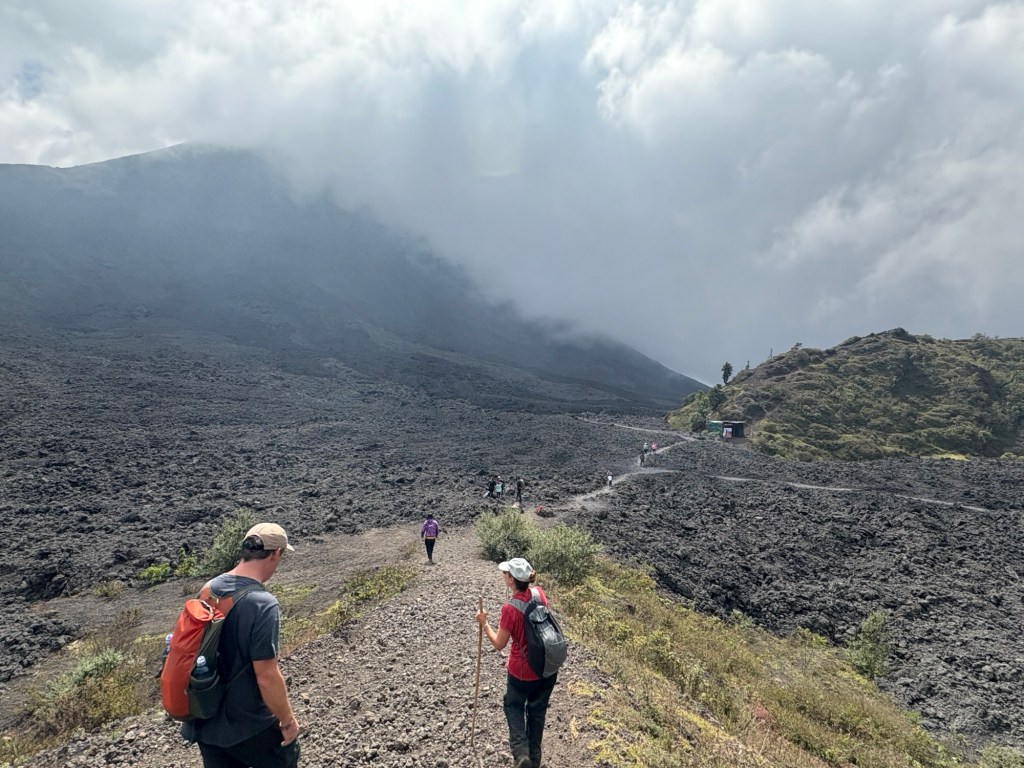
We wanted to do some more adventurous hiking, but we didn’t realize how popular the guided hikes were, especially at this time of year which is the busiest for the tour operators. We lucked out with a last-minute cancellation for a hike on Vulcan Pacaya. While the hiking was less extreme than other volcanoes in the area, Pacaya is still an active volcano and we were able to visit one of its lava fields.
Highlights:
‘Skiing’ down the mountainside. The ashen rock was so powdery! Check out Michelle’s dusty footsteps. Kind of reminds me of PigPen from the Peanuts.
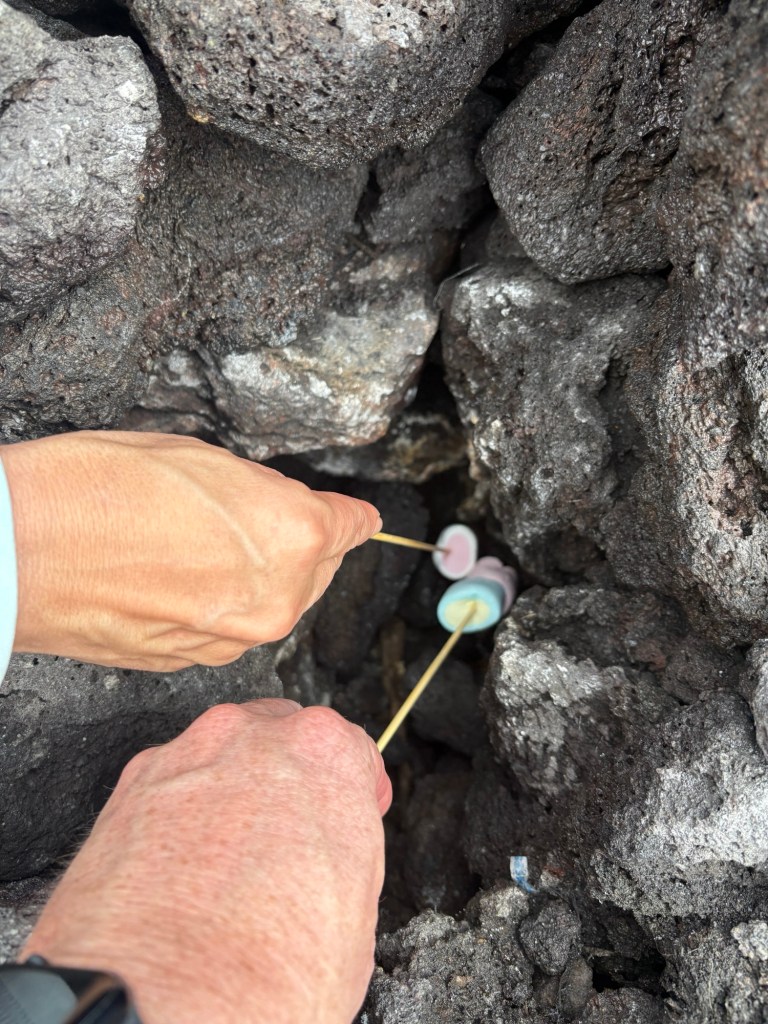
Roasting marshmallows over the vents in the lava field. The lava field was formed in the 1976 eruption. It was plenty cool to tread upon, but there were a number of shafts down into the rock where steam was escaping. The steam was hot enough to be uncomfortable on my hand, and it was enough to roast a marshmallow! (The tour guides were ready.)
Lava fields below Vulcan PacayaRoasting marshmallows in a steam vent
After the tour (and after a shower), we finished the day with a tasty local meal from a tiny restaurant around the corner from our hotel. The place is called Delicias de Abuelita which translates to Granny’s Delights. This was basically street food (home-made) with a small indoor seating area. We sampled everything on the menu! My favorite was the rellenitos and Michelle liked the doblatas.
Lowlights:
There was an hour-long van ride to the start of the volcano hike. The driving was fine, but we shared the van with a California family – friendly parents but their kids (adult kids, actually) were awful, awful awful!
DAY 4: Sat 12/28 – Mountain Bike around Lake Atitlán
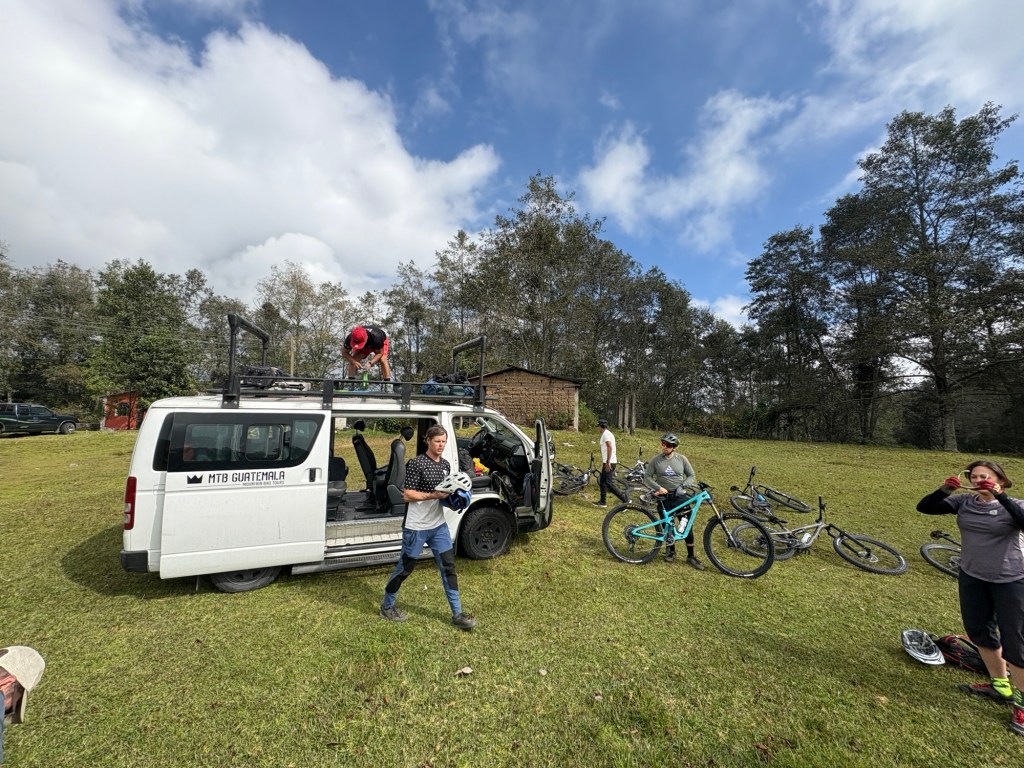
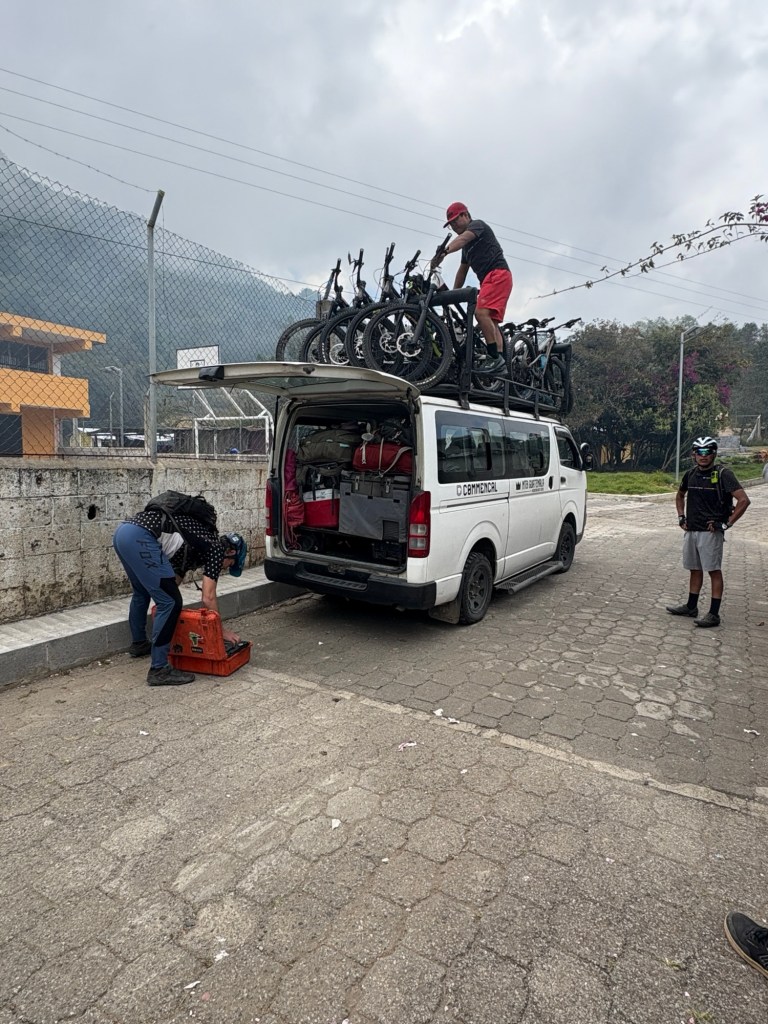
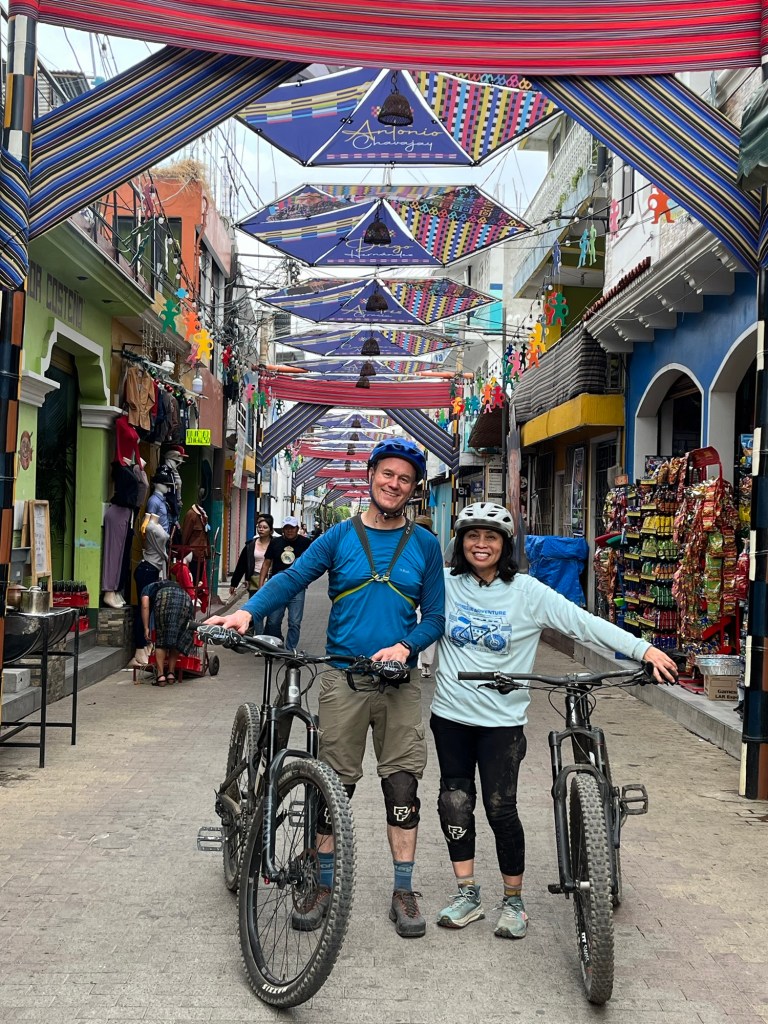
Many highlights from this bike ride – too many too list. We booked our tour through MTB Guatemala. This is a fantastic, professional operation and we totally lucked into it with a last minute sign-up. Brendon (owner and tour guide) worked hard to ensure all the logistics ran smoothly, the equipment was in good shape, and he and Oscar were very conscientious guides. We learned a lot about Guatemala in general and the region specifically. Very highly recommended – we will tour with Brendon again if we can!
Highlight of the trip! Unplanned lunch with local townspeople. This was an awesome experience, something you can’t ever plan, and only happens a few times, if ever, in a lifetime. I wrote a separate post just about this. (Link to Guatemala Part 2 – Village Celebration) This was one of my favorite moments of 2024. Really cool.
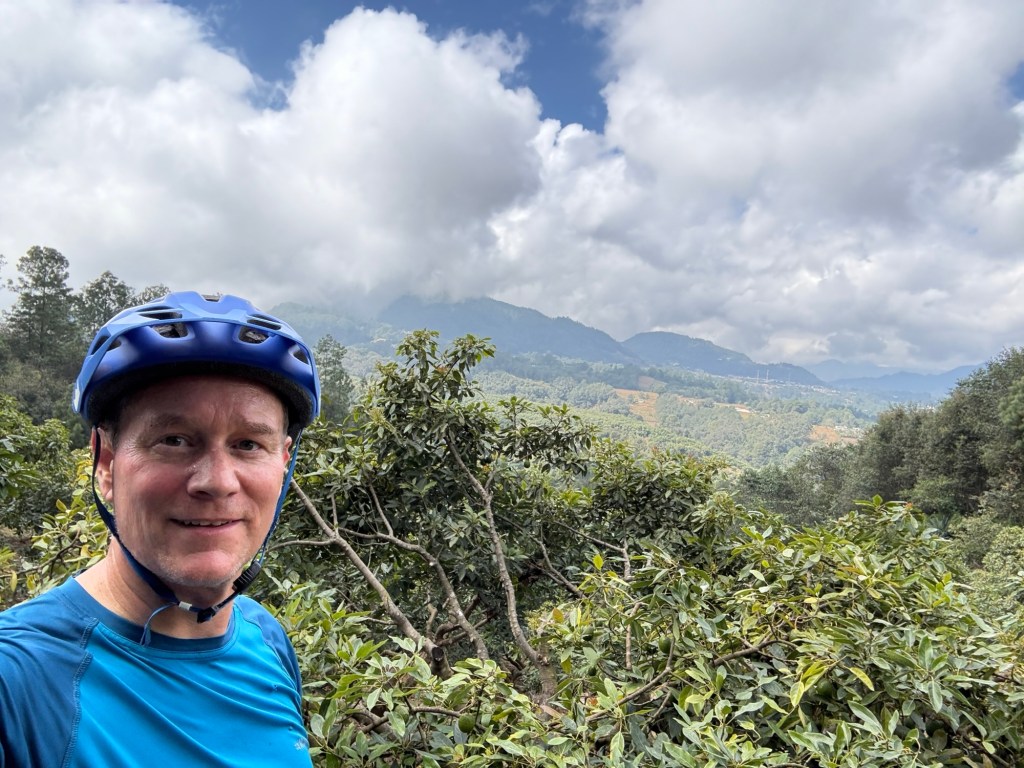
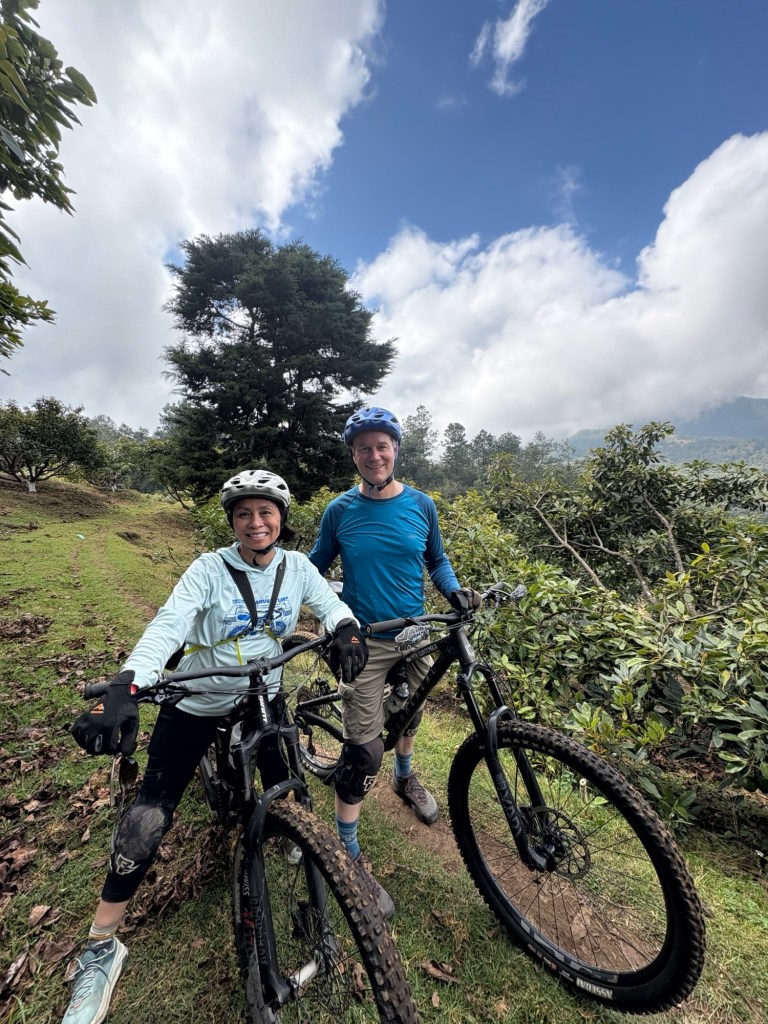
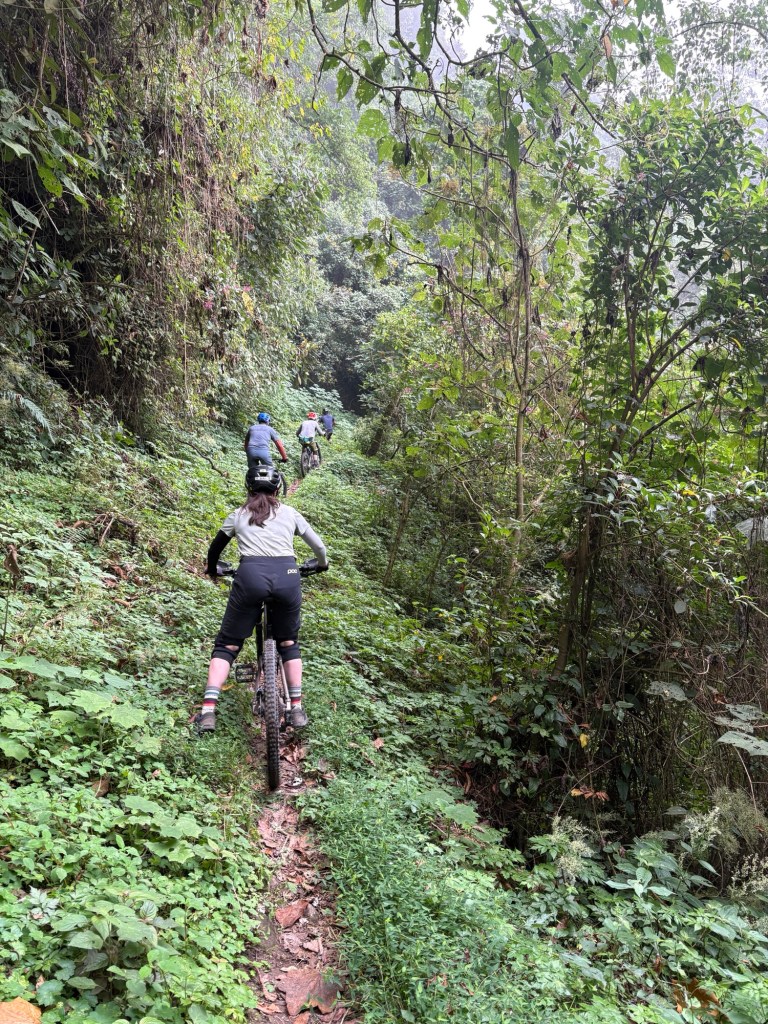
Some mountain biking photos:
Lowlights:
None! What an amazing day!
DAY 5: Sun 12/29 – Boat tour of Lake Atitlán and its waterside towns
The lake is surrounded by many villages in which the Maya culture is still present and traditional dress is worn. We had made friends with another couple on the mountain bike tour, and we split the cost hiring a private boat for the day. We visited four towns: Santiago, San Juan, San Marcos, Santa Cruz.
Highlights:
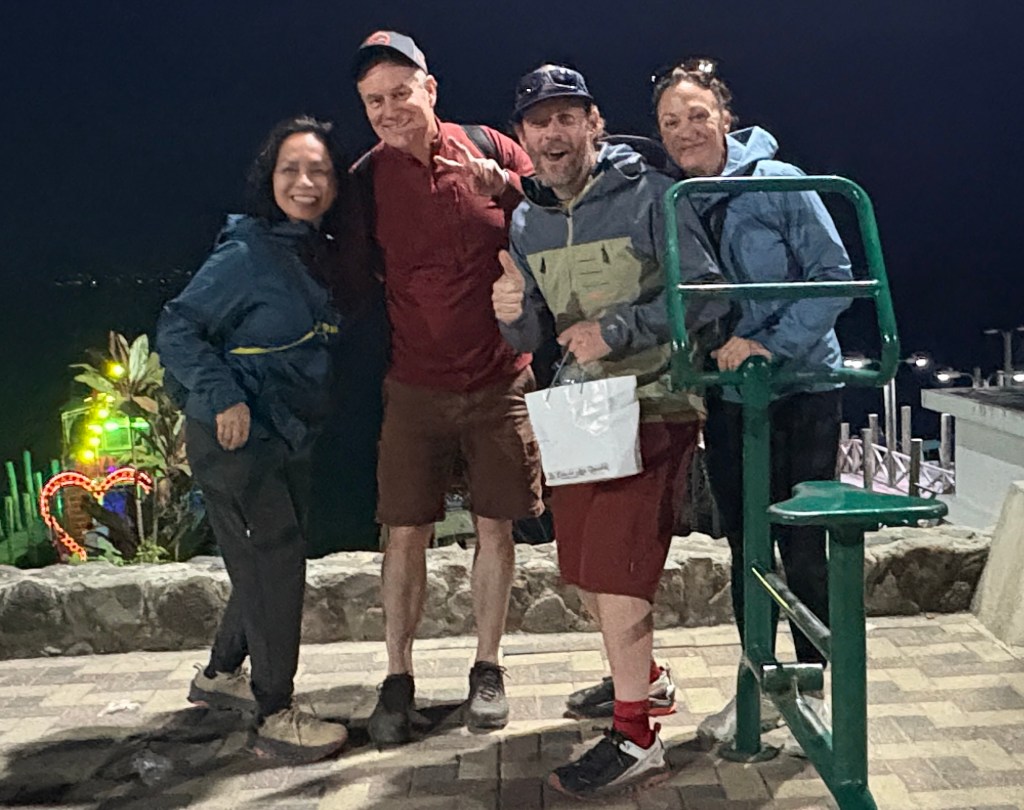
It was fun having other people to connect with. Scott and Jules are from Golden … just a few miles from Boulder! They’re fun, easy-going people and it made for an enjoyable day of shopping and exploring the little towns around the lake.
With Scott and Jules
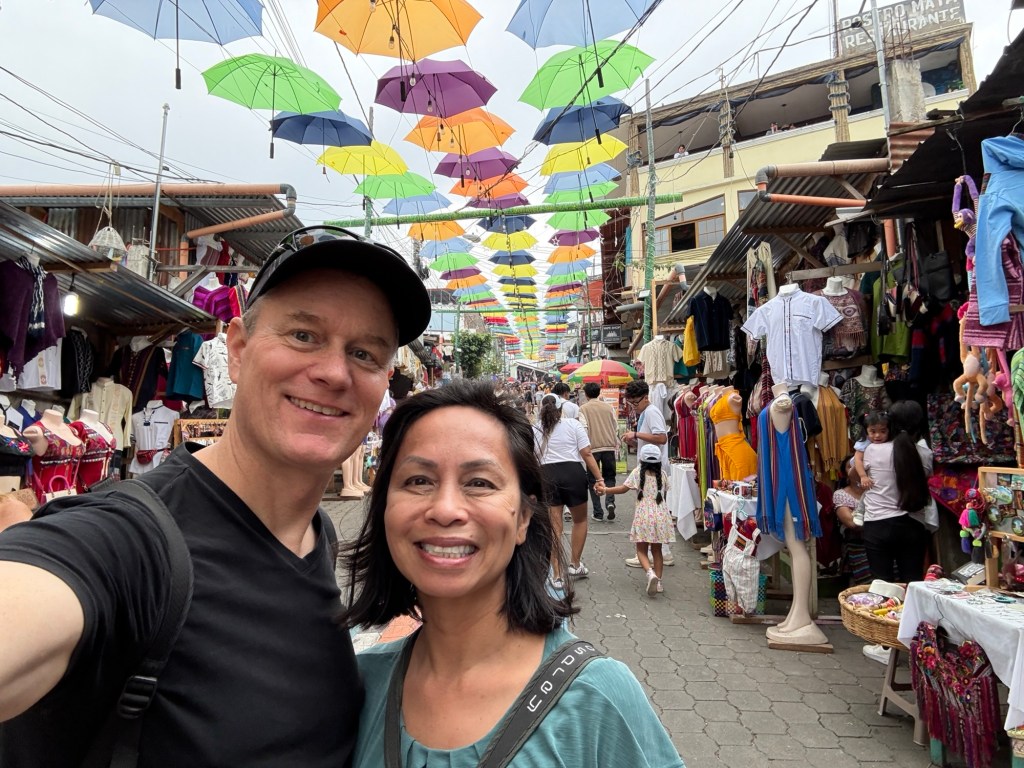
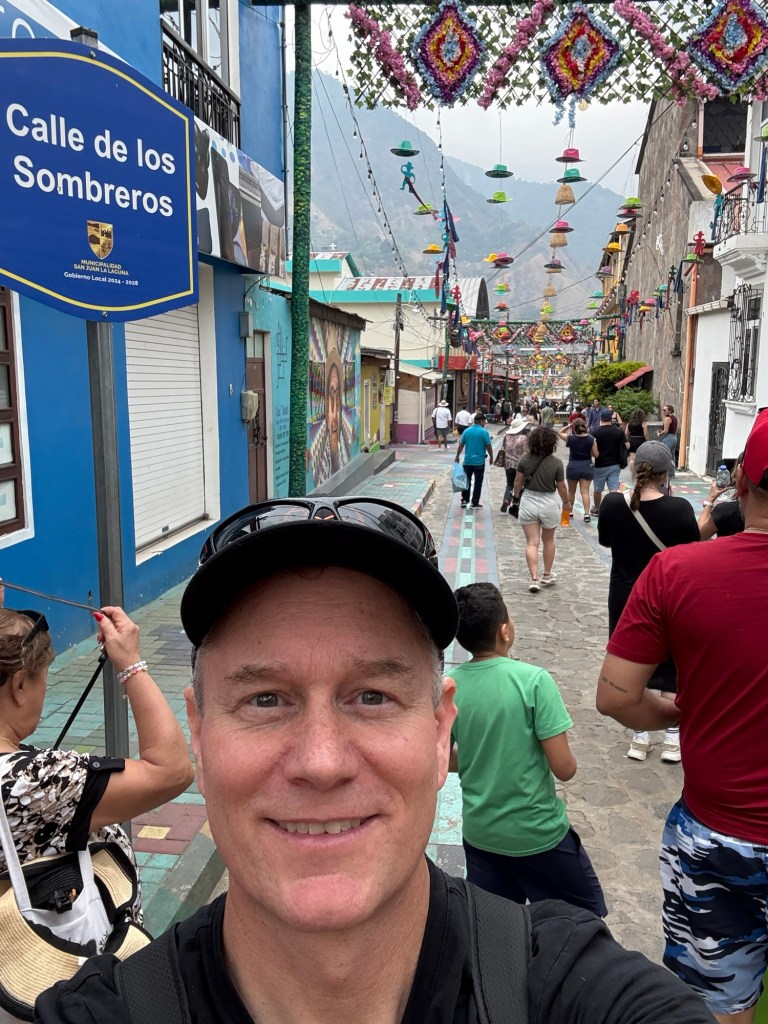
San Juan is a super colorful city. If there was a race with the other lake-shore towns to win the most tourist dollars, San Jaun has won it by painting Instagram-able murals, banners, and other beautiful engaging decorations throughout the town. Loads of people everywhere. Here is a photo of the main tourist road. Cool umbrellas!
Colorful
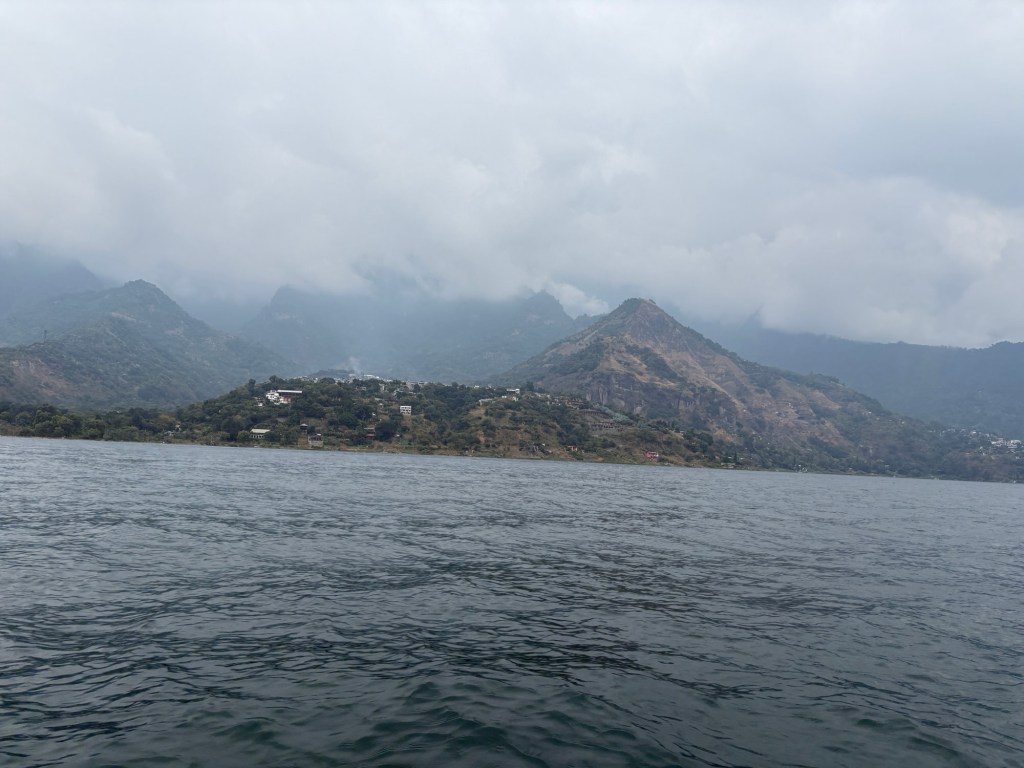
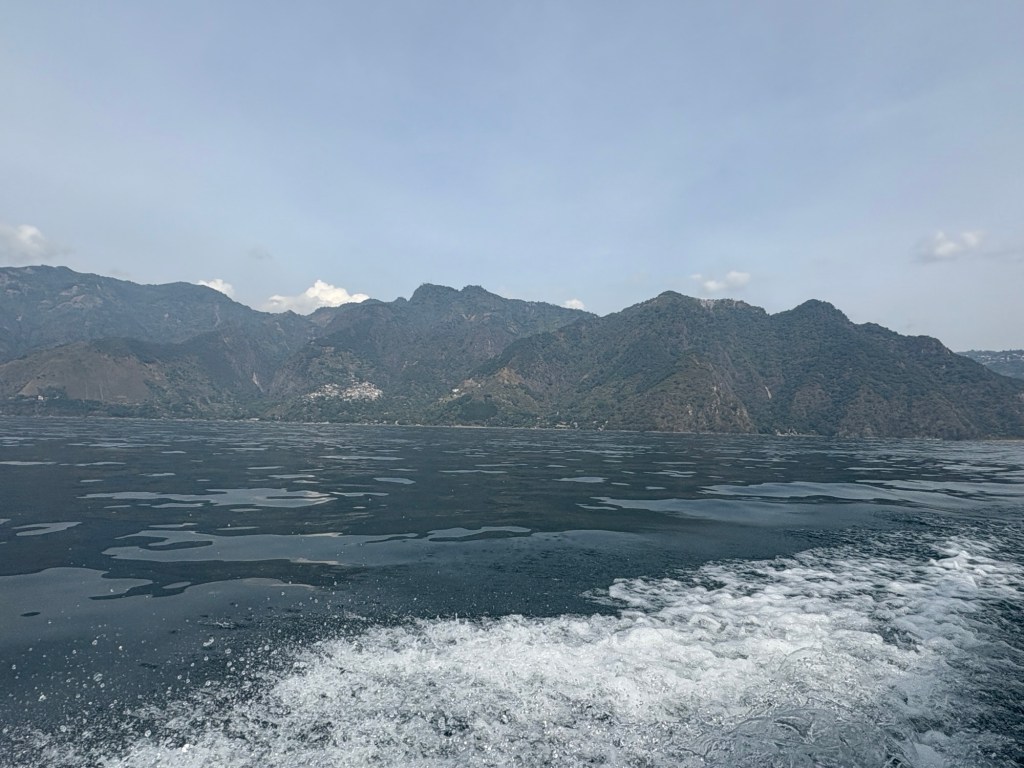
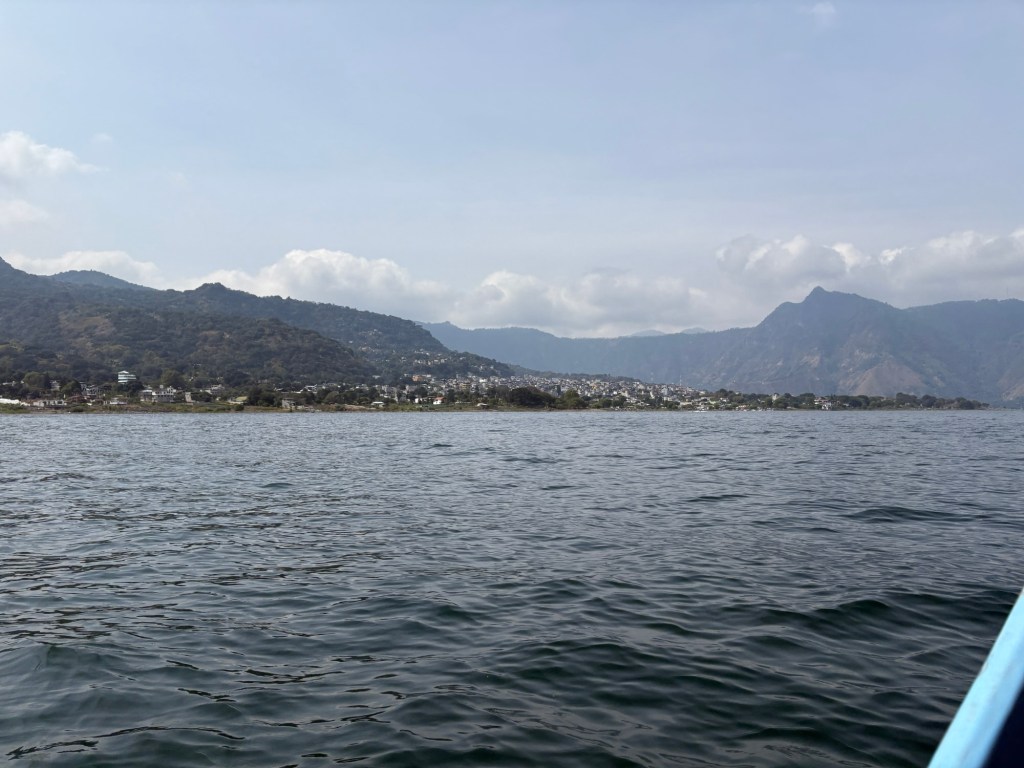
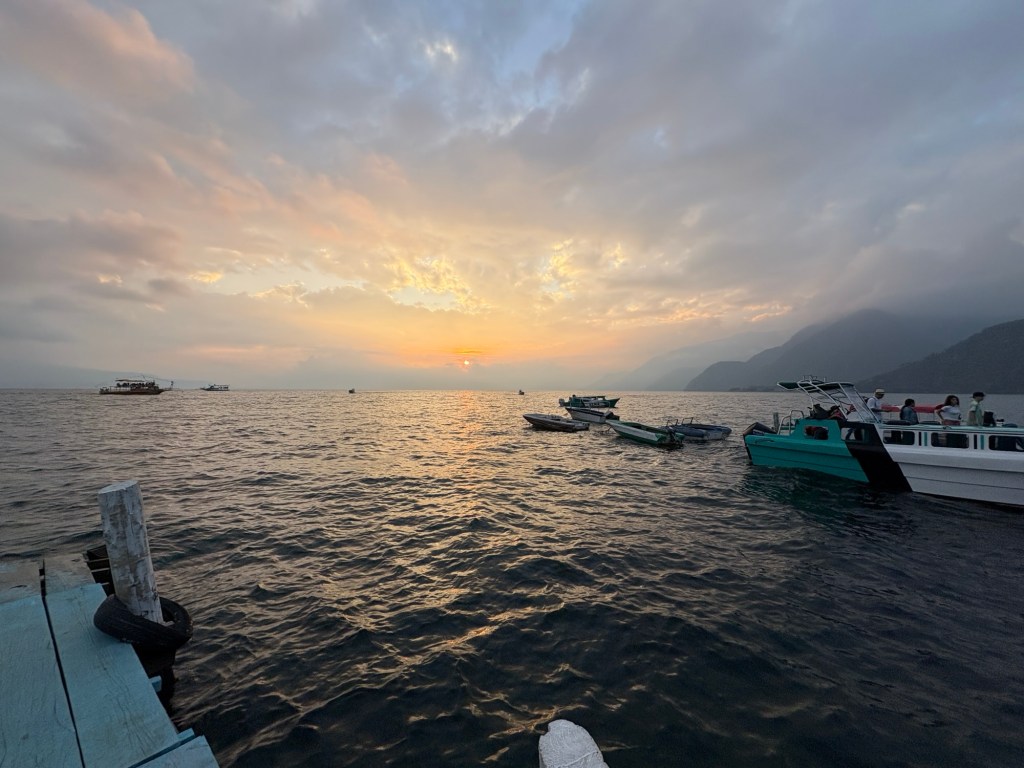
Views from the Boat
Lowlights:
San Marcos could have been a much nicer town. Seems like the hippies are too permissive about the dogs – there is literally dog $h!t everywhere. Disgusting. Also, the town is known as a spiritual destination, with yoga and meditation and massage. However from what we could see, all these places were behind closed or locked doors, as if they wanted to keep the riff-raff out. Maybe they need to do so, but it left an impression like the gringos had taken the town away from the locals.
DAY 6: Mon 12/30 – Rest and relax in Panajachel
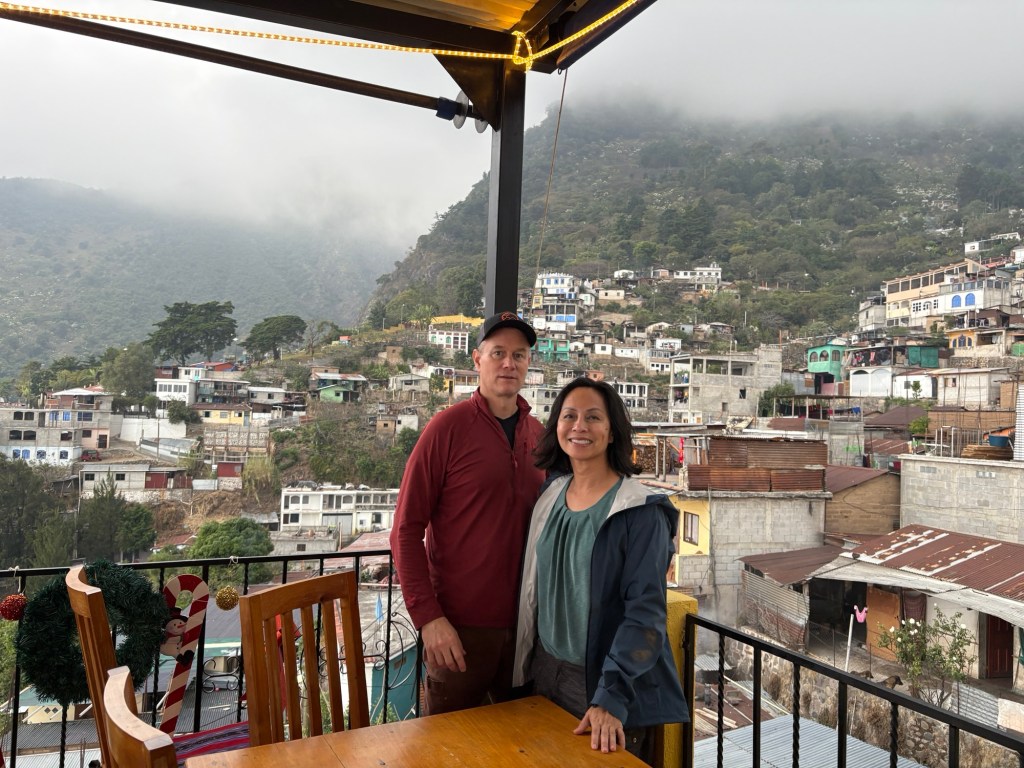
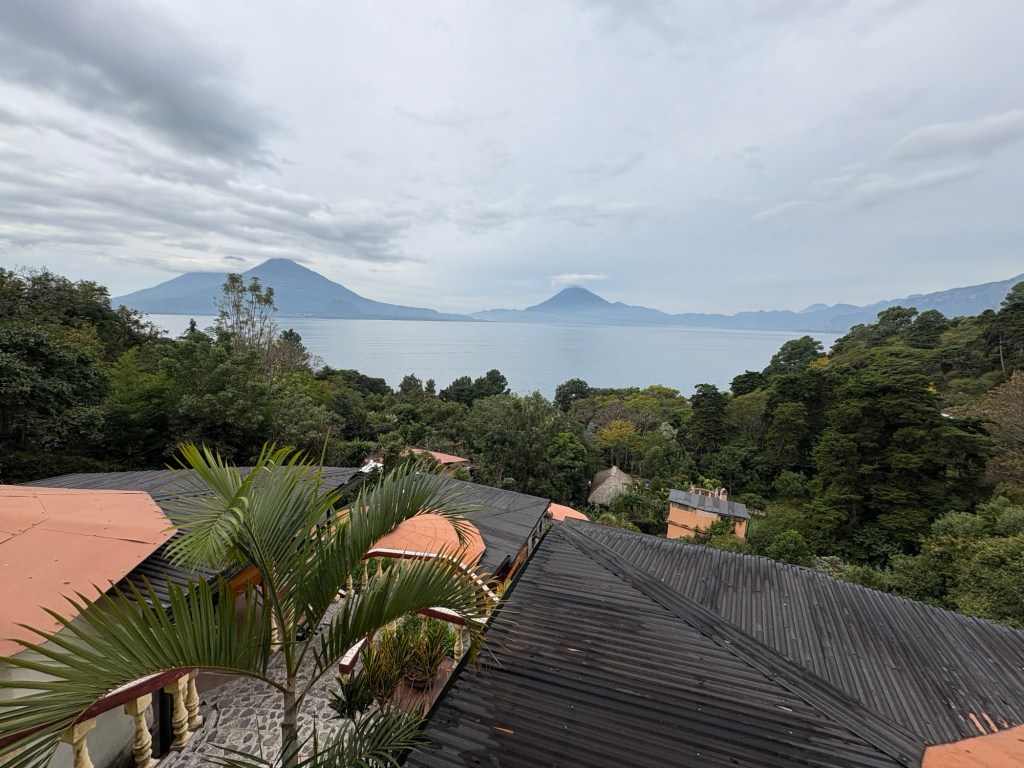
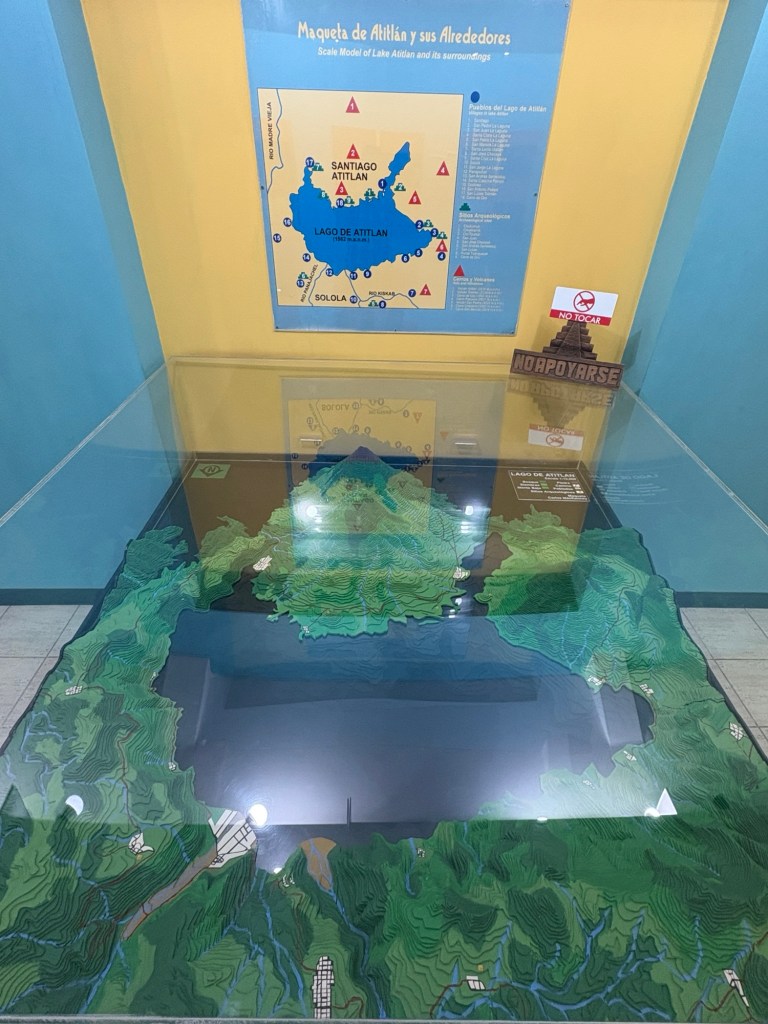
After five days of exploring, we enjoyed a day of R&R hanging at our beautiful Bed & Breakfast, called Jenna’s River B&B. It’s located a few hundred feet above the lake, looking out across the water toward two of the volcanoes that ring the lake. We slept in, had a late breakfast, read our books, journeyed into town for a few hours (there is a great museum where we learned a lot about the history and the geology of the region), and packed up for tomorrow’s long travel day.
Lake View from Jenna’s
Highlights:
The museum in Panajachel is small but worth a visit.
Meals at Jenna’s are a home-made affair.
Lowlights:
We wanted to find a nice restaurant in town, but most of the places we saw were tourist-oriented. We settled for another dinner at Jenna’s which was once again delicious.
DAY 7: Tues 12/31 – Travel day
Panajachel>Guatemala City>Houston>Denver>Boulder
Another fairly easy travel day. The flight from Houston>Denver was delayed but not terribly so. The roads surrounding Denver Airport were iced over which made for some white-knuckle driving, but the ice relented as we moved closer to Boulder, and we arrive home safely.
2024 was an incredibly long year, in the most positive sense possible.
I can’t measure it in terms of events, like my daughter‘s graduation or moving into a new home or performing music on stage with my friends.
I also can’t quite measure it by the amount of traveling during the year. There were many trips, from hiking/climbing in Ridgway, to mountain biking in Moab, hiking with my son and viewing fall foliage in Vermont, dropping my daughter at college in the United Kingdom, multiple camping trips, or even a recent vacation in Guatemala.
These metrics don’t really get to the heart of what made the year feel so long, so endless.
What made it feel long is the perpetual state of mindfully active growth. Whether it was home projects that I’d never faced; or traveling to new places; or the transition to empty nest; or navigating the world of independent freelance work, 2024 year was chocked full of new experiences and new problems to solve. There was very little repetition, and almost no routine.
This forced my brain to be constantly working – and my mind to always be open, learning. Even the tough days were rich, and every week felt like a month, because there was a lot of life happening.
Today, at the start of a new year, I feel grateful for the fullness.
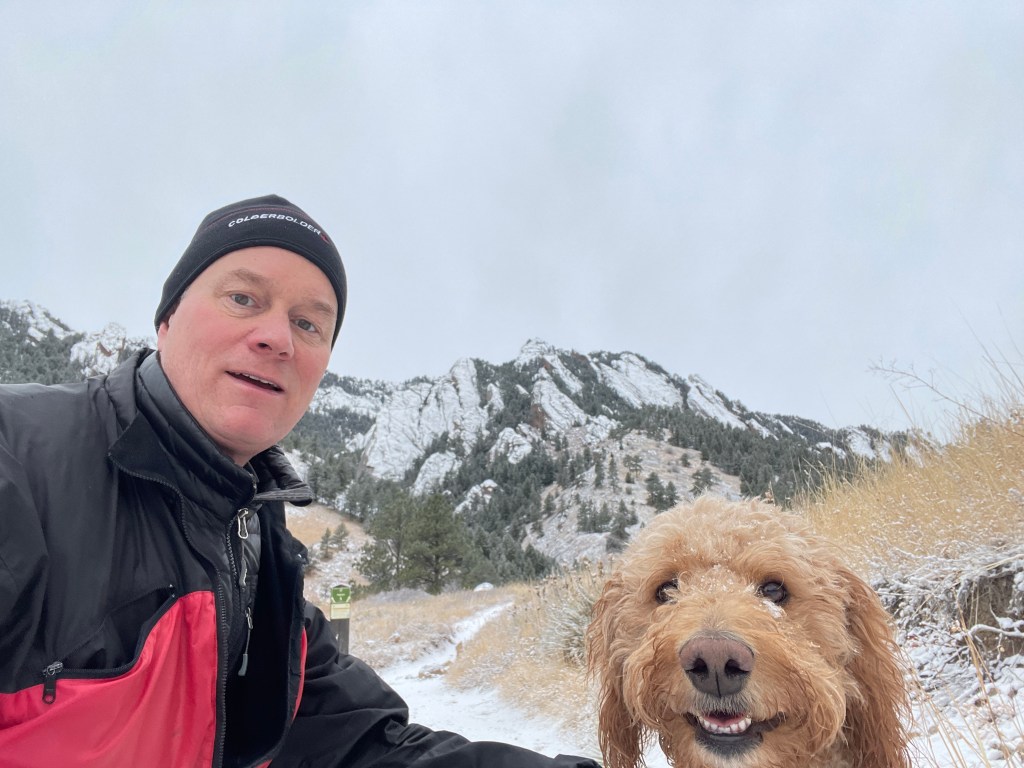
Sometimes it’s just right. This morning’s hike was supposed to be with another friend on a different trail, but when they canceled last minute I headed up toward NCAR with Cricket the endlessly effervescent pup. I randomly bumped into my friend Swavek. (What are the chances? If he’d reached that trail junction 15 seconds earlier we would have missed each other). We hatched a plan to run a trail relay next year. Just need to find 8 more people for our 10 person team!
I love the Boulder mountain trails under fresh snow. Not many people out this morning – maybe it was too cold. But for me and Cricket and Swavek it was just right.
Most of the sports that I do are solo endeavors. Rock climbing is an exception – that one is more fun (read: safer) with a partner. But most everything else – running, biking, hiking, snowboarding, snowshoeing, yoga, weightlifting, cardio, core are all things I can – and typically do – pursue by myself.
It’s unusual to engage with the world around me when I exercise. I can turn on some music, or often just let my thoughts run rampant, without interruption or distraction. To be clear, I don’t mind interruptions. It’s kind of nice to interact with other people on the trail or in the gym. But as an introvert I don’t typically initiate any dialogue with others.
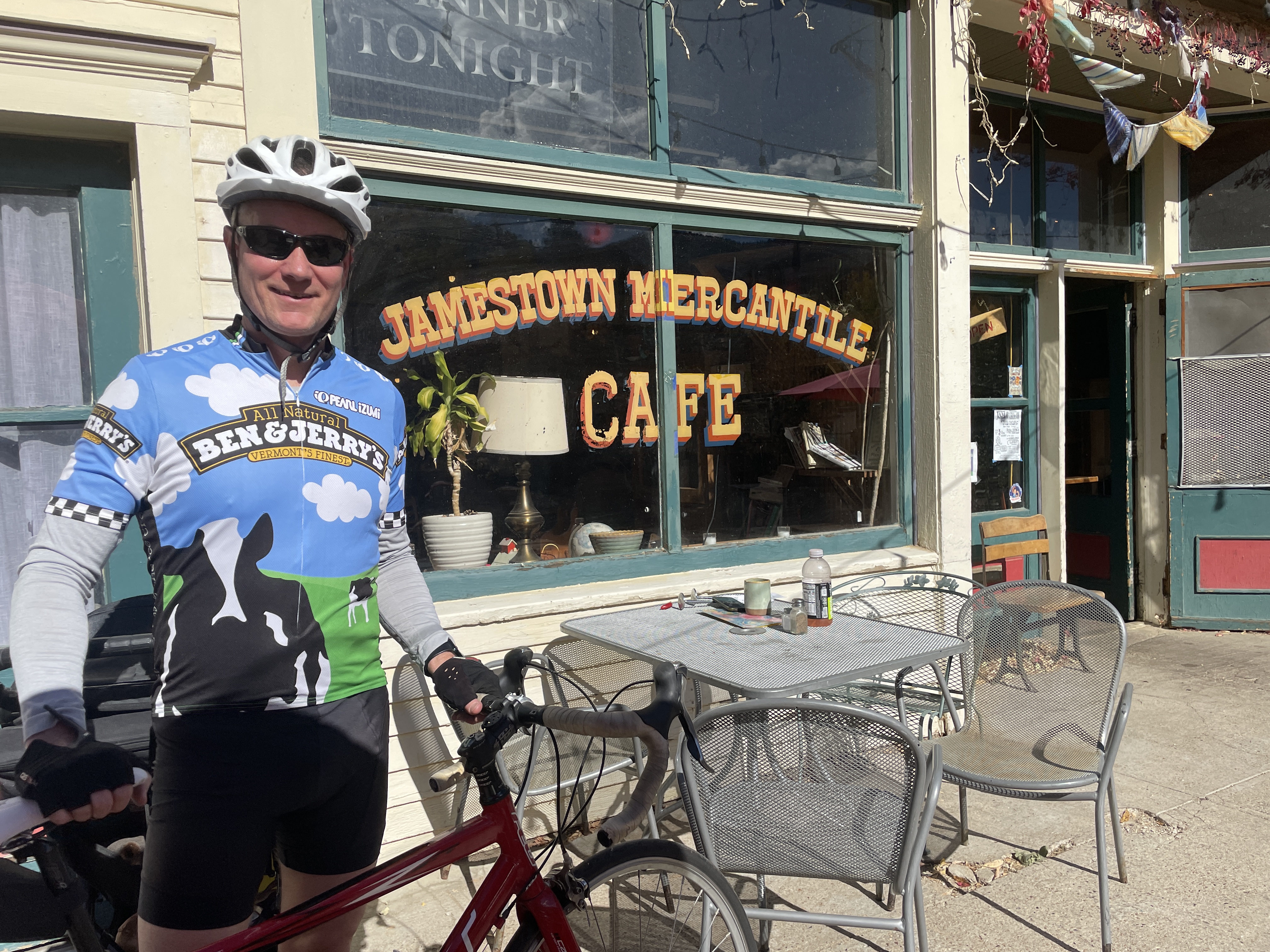
So it was a little unusual today, riding my bike up to Jamestown, to have not one but two people strike up a friendly conversation with me. Both times while I was stopped for a break, someone commented on my cycling jersey.
Sending a thank you to my brother, James, who gave me this jersey when he downsized several years ago. I inherited a bunch of great gear, including this jersey that has now created social opportunities (not just today but many other times as well) for this exercising introvert.
“Love is found in the things we’ve given up, more than in the things that we’ve kept.”
That’s a quote from a Rich Mullins song, and it’s been on my mind lately. It prompts a memory of an article I read many moons ago from David Brooks that made such an impact I paraphrased it for myself. I recently found my paraphrasing, even though I can’t locate the original article.
My paraphrasing of the David Brooks article:
There is huge pressure in our culture, and it influences how we think and what we do. We are told we need to be successful in our careers, that we need to be our own individual (“you do you!”) and that we can make ourselves happy if we focus on accomplishing the right things. Especially for young people, that we should go out and collect a bunch of experiences, and whoever collects the most wins. We tell these stories to each other hoping to win respect from others, but none of it leads to happiness – to those feelings of rich fulfillment.
Our culture is lying. What’s the truth about happiness? People on their death beds tell us happiness and fulfillment are not found through achievement but in committed, deep relationships. Family, friends, community.
The big lies our culture tells us:
1. Career success = fulfillment.
2. I can make myself happy.
3. Life is an individual journey.
4. You have to find your own truth.
No!
Happiness is found amid thick and loving relationships. In giving and receiving care. This is hard to do – it’s hard to communicate from your depths and not your shallows; it’s hard to stop ‘performing’ for other people, especially since we must ‘perform’ to earn an income.
No one teaches us how to do this.
The truth is, the people who have the best lives tie themselves down. They don’t ask, “What’s the next cool thing I can do?” They ask, “What’s my responsibility here?” They respond to some problem or get called outside of themselves by some deep love. By planting themselves in one neighborhood, or one organization, or one mission, they earn trust. They earn the freedom to make a lasting difference. It’s the chains we choose that set us free.
I’m closely investigating the possibility of working with multiple businesses as a fractional COO. This is a new space and many seasoned executives are looking at it, trying to figure out how to make it work. But what is a fractional COO? There seem to be a lot of different answers. Here is my vision and definition.
Just like a full-time COO, a fractional COO (fCOO) acts as a strategic partner with the business owner. The job of the fCOO is to enhance the existing leadership team into a group of people who can run the day-to-day without the the business owner’s constant intervention. The fCOO drives execution of the owner’s vision with the leadership team (and, by extension, the rest of the company).
The fCOO is the leader of the leadership team. This is not an outside consultant; the fCOO is part of the org structure and the leadership team reports to him or her, even in a fractional engagement. The fCOO ensures that all of the various functions and departments of the business are integrated with one another and that everyone is rowing in the same direction.
A VP/Head of Ops/General Manager, on the other hand, is just one member of the leadership team who reports to the fCOO. He or she is responsible for the actual product and/or service that the business provides to its customers or clients.
One reason for confusion between the fCOO and the VP/Head of Ops/GM roles is that in the majority of businesses where the COO is full-time, he or she also serves as the organization’s VP/Head of Ops/GM. 80% of the full-time COO role is managing the business operations day-to-day, and 20% of the role is strategic development of the owner’s vision.
The fCOO focuses on the strategic 20% of the role. That’s why it’s fractional (not full time). The fCOO may perform this service for multiple companies at the same time.
Based on my experience, when it comes to operations many small & medium companies are in a state of chaos. It’s not for lack of effort or desire, it’s because the way an organization works when it’s getting off the ground is chaotic. Everyone wearing multiple hats, people stepping up to pull all-nighters or do heroic acts. It’s awesome to watch and be a part of; however, that bust-down-walls do-whatever-it-takes mindset starts to get in the way as an organization matures.
The operations team knows the business and the clients; they keep the trains running by executing current processes, but they may not know how to scale. The fCOO helps install a scalable operating framework, customized for the business, into which the existing leaders can grow and manage as the business expands.
This is my working definition for a fractional COO role. In future posts, I’ll describe the scope of services and ‘how’ to approach this work on a fractional basis.
I’m about halfway through ‘Multipliers’ from Liz Wiseman. Great read, and I’m appreciating the Multipliers throughout my career who have challenged me to bring out my very best. Also the Diminishers who stifled teams.
The book focuses on LEADERS who are Multipliers or Diminishers, presumably because leaders have such a broad impact. But I think ANY team member can be a Multiplier. It’s the person who supports their mates when they’re having a rough go at the office or at home. It’s the person who holds themself to a high standard ‘just because’ and role models that for their peers. It’s the person who makes others light up when they come in the room. Multipliers are everywhere.
Best memory of today, and there was a good selection to choose from:
Quick run out to Costco and my daughter came along for the ride. Stopped at the Starbucks drive-thru as we sometimes do. A song from Dear Evan Hanson playing on Spotify, and she knows all the words. As we are pulling in I pause the song to figure out our order, but she keeps singing a capella. For another 30 seconds, it’s just her doing her thing without any music, whimsical smile on her face – and I stop the car short of the order kiosk to let her finish.
A minute earlier, I had been worrying about whatever needed to get done this week. Grocery shopping and bills and whatever else. Something smacked me out of my self-absorption and I’m grateful it happened. To let that go for a moment, remembering that my daughter will be in college a year from now.
Changes are coming, and I do believe there will be good stuff to experience through all those future days.
But this is the time we have now. Grateful for the smack that reminded me to savor these moments while they are here.
Setting targets is important for teams. Yes, picking attainable yet stretch goals is important. Yet we’ve all heard it’s the journey, not the attainment of the goal, that brings fulfillment. The process itself has power. Why? I think it’s because of the bonds we create with other people in the pursuit of shared goals – those bonds are the magic that connect and fulfill us.
‘Smoothness’ (aka ease) of life is not a great target. The ‘roughness’ of life comes from places where we humans rub against each other. When we remove all the friction from life, we rob it of meaning because we remove the opportunity to interact with other people. Convenience leads to emptiness.
The smoother life gets, the more we feel like weirdos amongst each other. We never take the time to get to know each other, because technology takes away the need for us to interact. To make time for what matters, we need to give up things that make life easier. And that can feel radical and even misguided in a world that seems to value convenience and speed and efficiency.
I’m not recommending to throw away all your appliances or cutting up your credit cards to pay in person with cash. But maybe there are a few opportunities in your life. Going to a restaurant versus ordering food online. Working face-to-face versus all-day zoom meetings.



 johnny88keys